Five developments shaping Japan’s power market this month, from the government’s plan to replace up to 14 nuclear reactors to a surge in solar curtailment that nearly doubled in a single month.
Nuclear status holds steady as Japan reveals a 14-reactor ambition
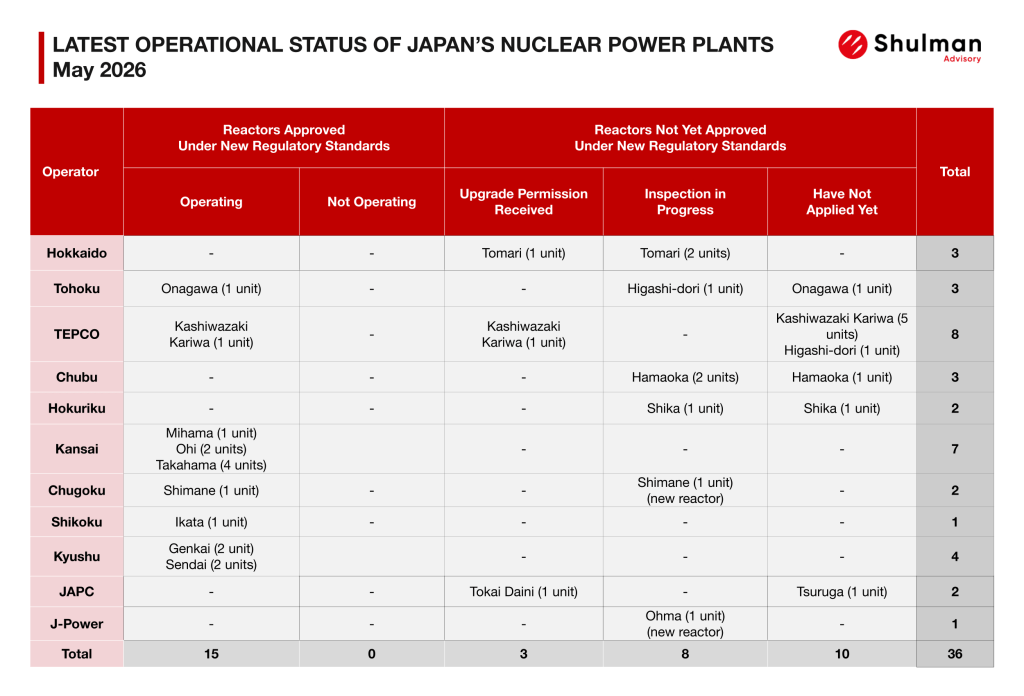
No change in Japan’s nuclear operational status in May, but the Japanese government has recently revealed its ambitious plan to replace up to 14 reactors by the 2050s, increasing nuclear’s share of generation from 8.5% (FY2023) to 20% by 2040 under the 7th Strategic Energy Plan. Before the March 2011 accident at the Fukushima Daiichi plant, Japan’s 54 reactors provided about 30% of the country’s electricity.
Switching volumes continue their post-peak cooldown
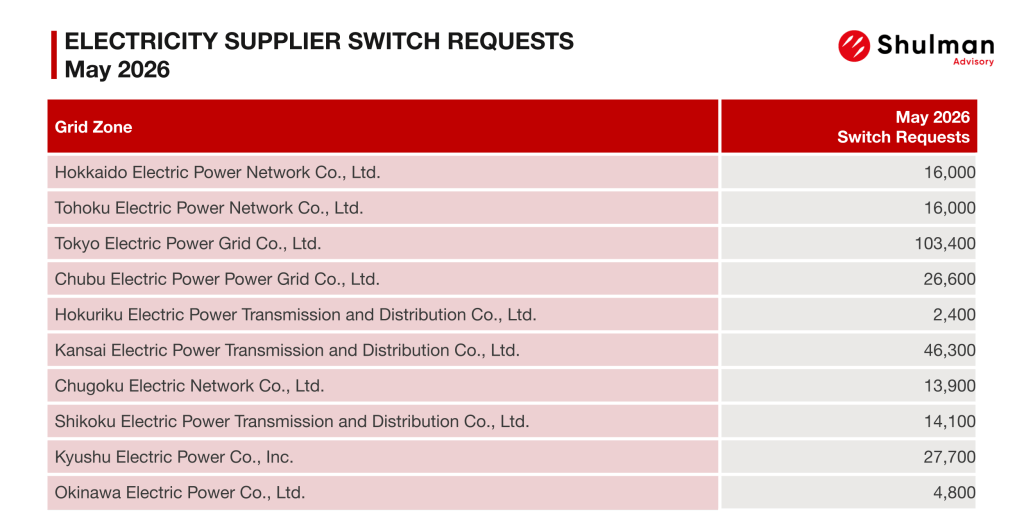
May 2026 switching volumes continued to ease across most grid zones, extending the post-fiscal-year-end moderation seen in April. Tokyo remained the national leader at 103,400 requests, down from 131,300 in April. Kansai similarly declined to 46,300, while Kyushu and Chubu softened to 27,700 and 26,600 respectively. Hokuriku remained the quietest zone nationally at 2,400 requests. The continued cooling across major zones is consistent with the seasonal pattern of switching activity settling in the months following the March contract renewal peak.
NFC auction signals strong demand as prices hold at the ceiling
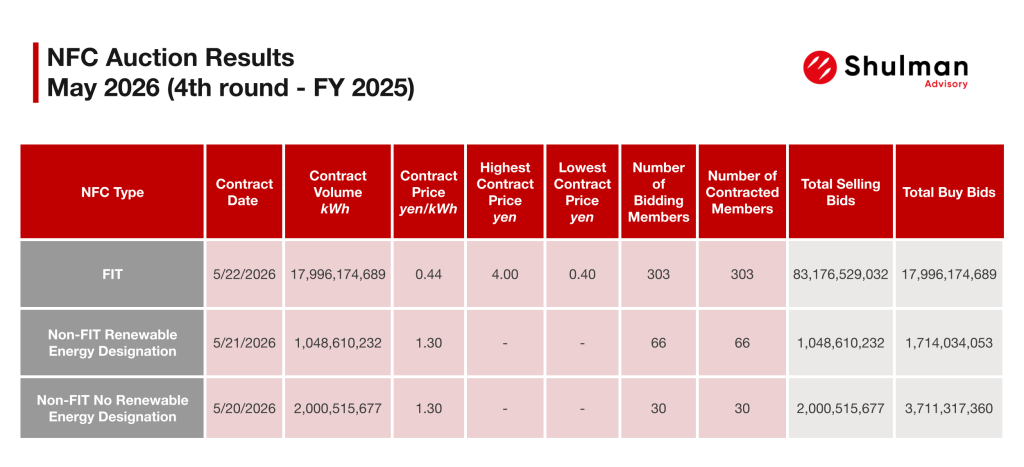
The latest FY2025 Non-Fossil Certificate (NFC) auction results suggest continued strong demand and competition for environmental value in Japan.
Non-FIT NFC prices remained at the ceiling price of JPY 1.30/kWh, while contracted volumes increased significantly: up 99.7% for Non-FIT No Renewable Energy Designation certificates (mainly nuclear-derived) and 27.8% for Non-FIT Renewable Energy Designation certificates.
Fuel cost adjustments edge up as earlier pressure reaches bills
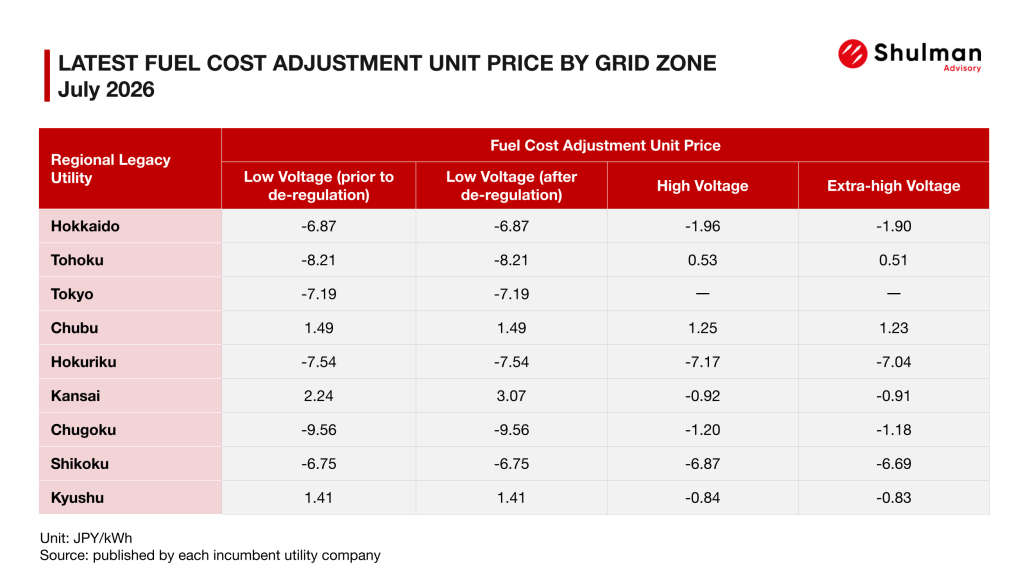
Japan’s fuel cost adjustments for July 2026 show a broad but modest upward shift, with most regions moving 0.10–0.30 JPY/kWh higher than June. Tohoku’s high-voltage adjustment rises from +0.40 to +0.53 JPY/kWh, while Chugoku’s low-voltage discount narrows slightly from -9.75 to -9.56 JPY/kWh. Kansai’s post-deregulation low-voltage figure ticks up from +2.97 to +3.07 JPY/kWh.
For context: these adjustments flow directly through to industrial electricity bills each month. Regional variations of nearly 13 JPY/kWh between the deepest discount (Chugoku) and highest surcharge (Kansai) for low-voltage customers mean substantial cost differences for energy-intensive operations.
July’s figures reflect March–April fuel costs, a period when crude oil and LNG import prices remained elevated. The broad upward drift across regions suggests some of that earlier import cost pressure is beginning to flow through to bills. Further movement is possible as summer demand patterns and upcoming fuel procurement data work their way into August and September adjustments.
Solar curtailment nearly doubles heading into summer
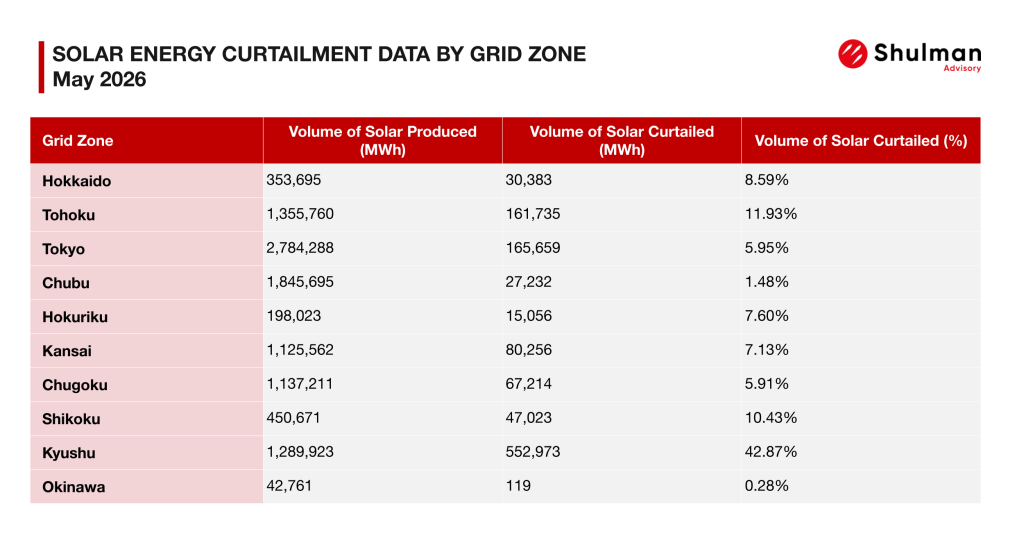
Solar curtailment surged further into early summer, with total curtailed volume across 10 regions rising from 585,390 MWh in April to 1,147,650 MWh in May. Kyushu again recorded by far the largest curtailed volume at 552,973 MWh, equivalent to 42.87% of total solar generation in the region, followed by Tohoku and Shikoku, where curtailment rates reached 11.93% and 10.43%, respectively.
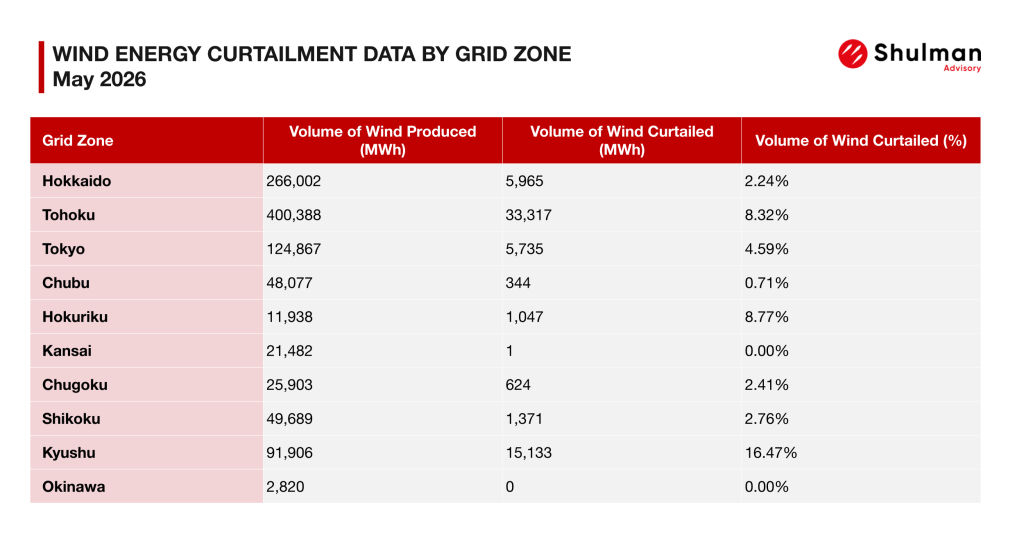
For wind power, total curtailed volume across the 10 regions also increased, reaching 63,537 MWh. Kyushu recorded the highest curtailment rate at 16.47% (15,133 MWh curtailed), followed by Hokuriku and Tohoku at 8.77% and 8.32%, respectively.
That’s this month’s read on Japan’s power market. Japan is charting a bolder nuclear future even as operational status remains unchanged, solar curtailment has nearly doubled heading into summer, and earlier fuel import pressures are beginning to reach industrial electricity bills. We’ll be back next month with fresh figures on switching, curtailment, fuel costs and the wider shifts shaping the market.