

Publication date: August 4, 2026
Key Takeaways
Japan’s BESS market continues to expand, but its policy environment is becoming more demanding, with new domestic battery manufacturing targets, tighter grid connection procedures, and lower Balancing Market price caps.
As the market matures, project viability will depend less on exceptional balancing revenues and more on securing grid access, managing development risk, and combining multiple revenue streams.
Japan’s BESS Market Evolves with a New Battery Strategy, Grid Reforms, and Lower Balancing Market Price Caps
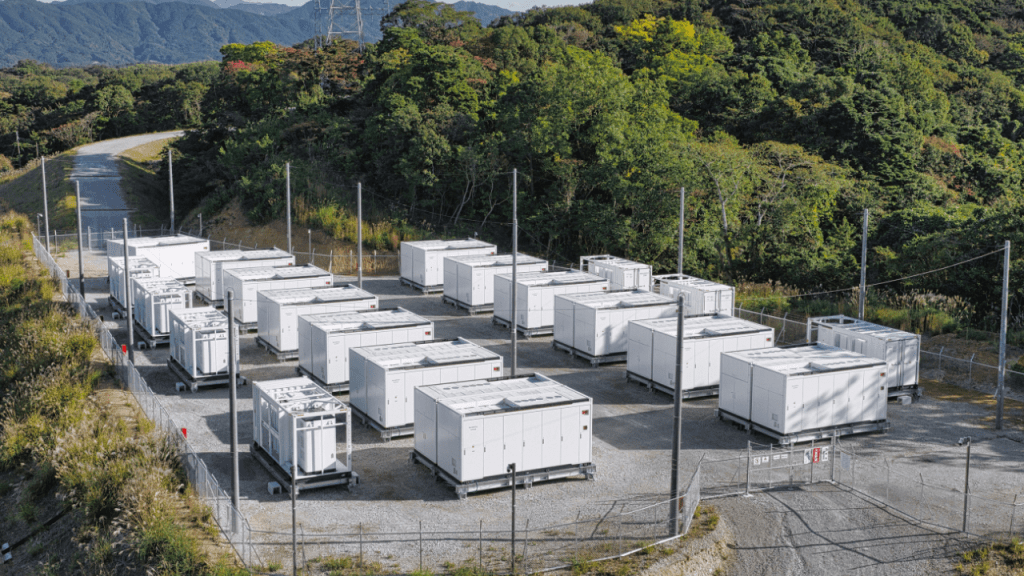
Japan’s BESS sector has remained one of Japan’s most active areas of energy policy in 2026. As deployment accelerates, the government’s focus is shifting from simply encouraging investment to ensuring projects can be developed and operated efficiently. Recent measures include manufacturing support, tightening grid connection procedures, and revisions to the Balancing Market rules – reflecting the increasing maturity of the market.
New Battery Strategy aims to expand domestic manufacturing capacity
In June, METI revised the Battery Industry Strategy initially formulated in 2022 and renamed it the Battery and Power Supply Industry Strategy. The revised strategy focuses on strengthening domestic manufacturing capacity and industrial competitiveness, including:
- Build annual domestic manufacturing capacity to 150 GWh by the early to mid-2030s, compared with the current approximately 120 GWh.
- Roughly triple Japanese companies’ global battery-related sales between 2025 and 2035. Sales stood at approximately JPY 1.7 trillion in 2025, implying a target of more than JPY 5 trillion.
Rapid expansion brings tighter oversight of grid connection procedures
At the same time, the rapid increase in BESS development has placed considerable pressure on Japan’s grid connection process. OCCTO’s report on connection activity in FY2025, covering April 1, 2025, to March 31, 2026, illustrates the scale of the increase. General transmission and distribution utilities received a record 28,927 connection study requests, more than double the 14,276 received in FY 2024. BESS projects accounted for 24,880 requests, or approximately 86% of the total, while solar projects ranked second at around 13%. The TEPCO Power Grid service area recorded by far the largest number of requests (12,052) and the largest year-on-year increase, followed by Tohoku and Chubu.
One of the major drivers of the increase in requests is developers’ capacity hoarding behavior. In some cases, a single company submitted more than 100 requests within a short period, causing delays in transmission and distribution utilities’ processing (Nikkei). The government has introduced several measures intended to screen out low-feasibility projects:
- From June 2026, the deposit required when applying for a grid connection agreement increased from 5% to 10% of the estimated grid construction cost.
- From August 2026, each grid company will cap the number of connection studies that a single company can request within its service area.
- From October 2026, developers will need to submit documents demonstrating rights to the proposed project site when requesting a connection study.
These measures are intended to improve the credibility of the project pipeline and prevent speculative applications from consuming administrative and grid-planning capacity.
METI reduces Balancing Market price caps further
Since its phased introduction in 2021, the Balancing Market has provided an important source of revenue for grid-scale BESS operators. The Balancing Market allows transmission system operators (TSOs) to procure balancing capacity/flexibility (ΔkW) from asset holders, including BESS. So far, high clearing prices have allowed some early projects to recover initial investment costs very quickly. However, METI became increasingly concerned about limited competition and bidding close to the applicable price caps.
Earlier in 2026, METI lowered the price cap for Frequency Containment Reserve (FCR, or Primary Reserve), Synchronized Frequency Restoration Reserve (S-FRR, or Secondary Reserve 1), and combined products from JPY 19.51 to JPY 15/ΔkW-30-min. However, reviews of trading activity following the change did not show sufficient improvement in market conditions, and METI decided to reduce the applicable price cap further, from JPY 15 to JPY 10/ΔkW-30-min, from September 2026. The ministry will continue to monitor market activity with the potential to further reduce the cap if necessary.
Japan’s BESS market continues to offer significant long-term growth opportunities, but the path to commercialization is becoming more demanding. As government support shifts from accelerating deployment to improving market quality, project viability will depend less on capturing exceptional balancing market revenues and more on securing grid access, managing development risk, and stacking multiple value streams. Companies that can combine strong commercial execution with a clear understanding of Japan’s evolving regulatory environment are likely to be best positioned as the market matures.

________________________________________________________________________________________
Shulman Advisory supports foreign players in navigating policy, market design, and commercial execution.