Publication date: May 26, 2026
Japan’s Perovskite Solar Market Projected to Reach 12.5 GW by FY2040
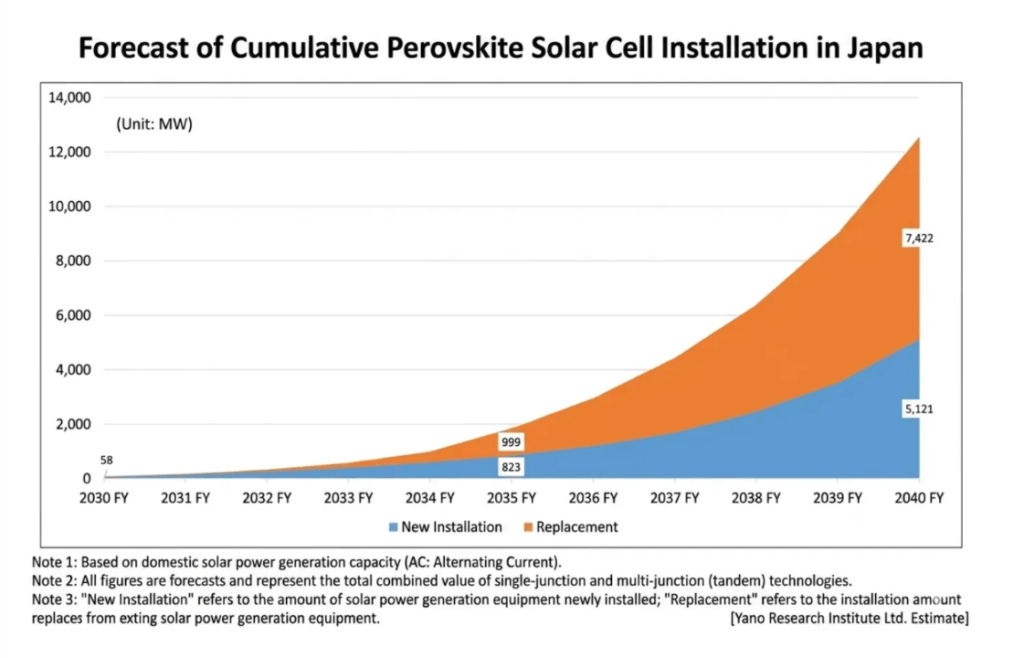
Yano Research Institute released a forecast for Japan’s perovskite market, including tandem-type cells that stack multiple solar cell layers. The institute projects that total domestic installations of single-junction and tandem-type perovskite solar cells will reach 1.822 GW in 2035, consisting of 823 MW of new installations and 999 MW of replacement demand. By FY2040, the market is forecast to expand to 12.54 GW, with 5.12 GW of new installations and 7.422 GW of replacement demand.
Japan’s 7th Strategic Energy Plan, approved by the cabinet in February 2025, projects solar power will account for 23–29% of the country’s electricity generation mix in FY2040 and sets a deployment target of approximately 20 GW for perovskite solar cells by 2040. Achieving this target will require not only expanding installation areas but also improving power-conversion efficiency per unit area through tandem-cell technology.
Assuming a 20-year lifespan for solar panels, replacement demand for systems massively deployed under the Feed-in Tariff (FIT) scheme is expected to emerge from 2032 onward, mainly at sites currently using crystalline silicon panels. While crystalline silicon panels generally last around 20 years, perovskite solar cells currently offer only about half that durability, prompting domestic manufacturers to target 20-year durability in ongoing development efforts. However, prolonged development timelines could increase the risk of losing market share to lower-cost overseas products with acceptable quality standards, highlighting the need for a development approach targeting applications where current durability levels of around 10 years are sufficient.
🔍 Shulman Commentary:
The Institute’s report also suggests that maintaining competitiveness against overseas perovskite products will require establishing domestic market advantages by applying Japan-specific safety and environmental standards. In late March, Sekisui Chemical began commercial production of perovskite solar cells, marking what could become the beginning of a new phase for Japan’s solar power sector.