Publication date: March 10, 2026
Japan Data Center Market Update 9: Japan’s Data Center Market Shift Toward Edge and High-Speed Optical Infrastructure
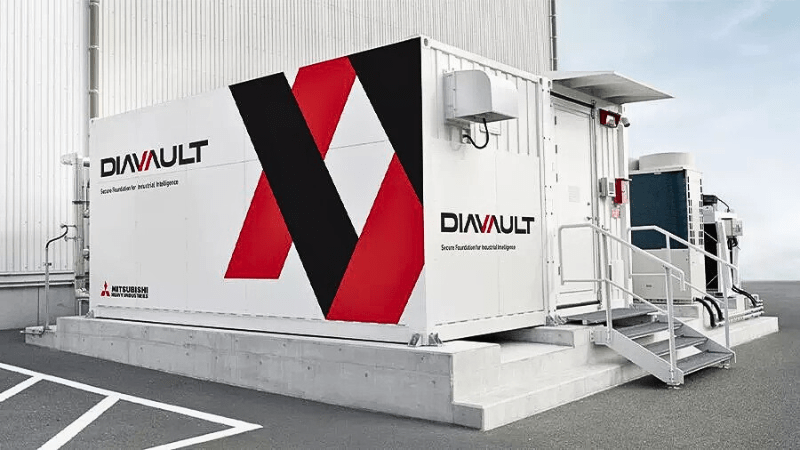
MHI Launches DIAVAULT, an On-site Edge AI Data Center for Real-time Processing
On February 24th, Mitsubishi Heavy Industries launched its proprietary industrial edge data center solution, “DIAVAULT,” designed for on-premise AI inference use cases. The system can scale from small deployments to multi-megawatt inference facilities, targeting manufacturing sites, research facilities, defense applications, and low-latency 5G-connected environments.
As IoT and AI drive growing demand for real-time processing of massive data, challenges such as latency and data security in cloud-centric models are increasing the importance of edge computing, which enables fast, distributed processing closer to where data is generated and used.
A demonstration AI data center has been set up at the Yokohama Hardtech Hub (YHH) which has next-generation GPU servers cooled by a water-free, two-phase direct-to-chip liquid cooling system. The server room is compact, equivalent to two 20-foot containers, but is designed with sufficient space to accommodate deep, large-scale servers and allow maintenance access to the coolant distribution units. It is also equipped with a continuously powered uninterruptible power supply (UPS).
NTT Advances All-Photonics Network for Distributed Data Centers
NTT is accelerating development of its all-photonics network (APN), the core technology of its IOWN initiative, aiming to expand optical transmission further in side data centers and even within servers themselves. In conventional systems, data travels as light through fiber cables but is repeatedly converted into electrical signals once it reaches buildings and equipment. Each of these conversions adds delay and consumes power. By keeping data in light form for longer, APN reduces this inefficiency, lowering latency and energy use while allowing large volumes of data processed across multiple, geographically dispersed DCs to function as if they were operating almost as a single, integrated system in near real time.
NTT plans to commercialize “board-to-board” optical interconnection in FY2026, followed by “chip-to-chip” optical connections in FY2028. Even today, APN cuts network latency to roughly one-two-hundredth of conventional systems, and extending optical connections to the board level is expected to boost transmission capacity by more than six times.
The technology supports distributed AI processing across DCs located hundreds of kilometers apart, with real-time aggregation. Demonstrations include remote factory defect inspection using AI hosted in distant DCs, and ultra-low-latency live entertainment streaming at the Osaka-Kansai Expo. NTT is leading R&D, while NTT Docomo Business is advancing commercialization and solution deployment.
–