Publication date: Feb 10, 2026
Data Center Market Update 4: DC Growth Drives Power Integration and Hyperscale Development
Japan to Pilot Workload Migration to Align Data Centers With Surplus Electricity
The Nikkei reported that Japan’s Ministry of Internal Affairs and Communications (MIC) will launch a demonstration project in spring 2026 to connect geographically dispersed data centers via high-speed optical networks, advancing “watt-bit integration” between power and digital infrastructure. The initiative will test whether computing workloads can be shifted in real time to regions with surplus electricity to improve system efficiency.
The pilot is expected to involve utilities, telecom carriers, and data center operators, using photonics-electronics convergence technology to minimize latency. The effort responds to growing regional imbalances, with high renewable penetration areas such as Kyushu facing curtailment while data center hubs around Tokyo encounter tighter power supply. Redirecting workloads through communications infrastructure could offer a faster, lower-cost alternative to building new transmission capacity, with commercialization targeted for the late 2030s if the concept is proven.
—
Real Estate Developer Tokyo Tatemono Enters Hyperscale Data Centers With JPY 100 bn Osaka AI Campus
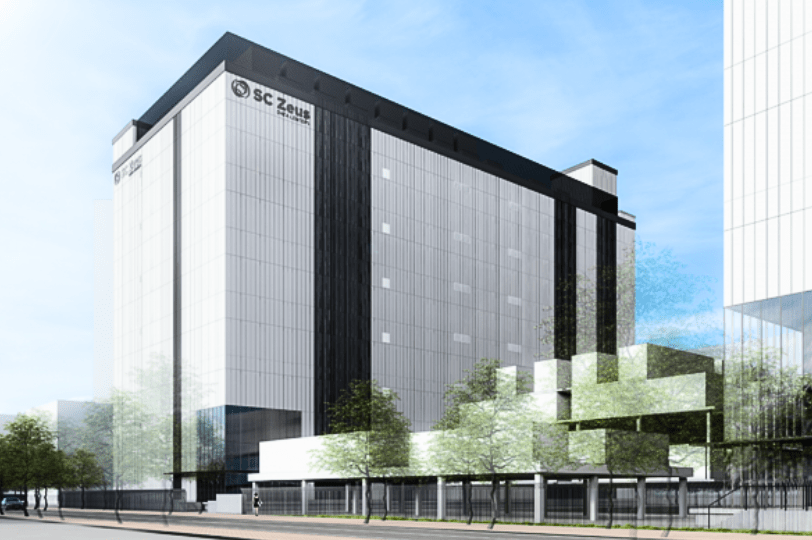
Tokyo Tatemono announced its full-scale entry into data center development, marking a strategic expansion beyond its core office and residential businesses. Its first project, “Zeus OSA1,” is a hyperscale data center jointly developed with Singapore-based developer and operator SC Zeus Data Centers in the Nanko area of Suminoe Ward, Osaka, with total investment reported at around JPY 100 billion.
The site is located roughly 10 km from Osaka’s main data center clusters and major internet exchanges, making it suitable for latency-sensitive uses such as AI inference and financial workloads. As a bayfront location, it also offers advantages critical for hyperscale projects, including the ability to secure large power intake, efficient transport and replacement of heavy equipment, and room for future expansion.
Phase 1 broke ground in December 2025, with operations scheduled to begin in 2028. Initial IT load is planned at 25 MW, with the campus designed to scale up to around 50 MW over time. The facility targets high-density AI and high-performance computing workloads, supporting rack densities of roughly 120–130 kW, liquid cooling, N+1 or higher redundancy, and a planned PUE of around 1.2. Overall, Zeus OSA1 is positioned as a campus-type hyperscale data center that allows phased investment and operational flexibility as AI workloads and power requirements continue to evolve.